
Data and artificial intelligence (AI) are now central to how FMCG/CPG brands and retailers operate, but their value is often unevenly realised.
Most organisations have access to more data than ever before. From retailer sales feeds and media platforms to first-party customer data and internal performance metrics. The challenge is no longer data availability, but how effectively that data is connected, interpreted and applied to decisions.
In FMCG/CPG and retail, data and AI are most valuable when they support faster, better-informed decision-making across pricing, promotions, media investment, assortment, supply and growth strategy.
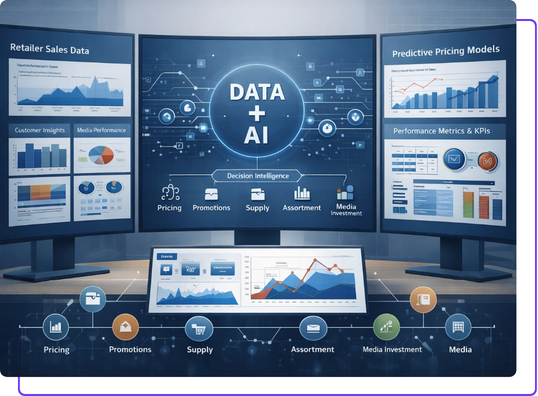
In practical terms, data and AI are applied across several core areas:

Commercial and category decision-making, including pricing, promotion effectiveness and range optimisation
Commerce and omnichannel performance, using data to understand how shoppers behave across digital and physical touchpoints
Retail media measurement, connecting media investment to sales and business outcomes
Demand forecasting and planning, improving accuracy across supply and inventory
Marketing and performance analytics, supporting attribution, targeting and budget allocation
Rather than replacing human judgement, AI and advanced analytics increasingly act as decision support tools by helping teams identify patterns, risks and opportunities that would be difficult to spot manually.
Historically, many FMCG/CPG and retail organisations have used data primarily for reporting and hindsight analysis.
The current shift is toward:

Predictive insights rather than descriptive dashboards
Scenario modelling rather than static forecasts
Continuous optimisation instead of periodic reviews
This evolution requires changes not only in technology, but also in operating models, skills and ways of working across teams.
Despite increased investment, many organisations struggle to scale the impact of data and AI. Common challenges include:
Fragmented data sources across retailers, platforms and internal systems
Disconnected teams, where insights are not translated into action
Over-reliance on tools, without clear use cases or ownership
Difficulty measuring impact, particularly across media and commerce
Skills gaps, especially at the intersection of data, commercial and marketing functions
Addressing these challenges requires alignment between data strategy, business priorities and organisational design.
Applied AI in this context refers to practical use cases that support day-to-day and strategic decisions, such as:
Identifying drivers of sales performance across channels
Optimising pricing and promotions using predictive models
Connecting retail media activity to incremental outcomes
Supporting category planning and portfolio decisions
Improving demand forecasting and operational efficiency
The focus is on relevance, transparency and usability—ensuring insights are trusted and adopted by commercial teams.
Data and AI strategies in FMCG/CPG and retail differ from those in other sectors.
Key factors include:
High product volumes and short lifecycle decisions
Complex retailer relationships and data access constraints
Multiple overlapping performance metrics
Pressure to demonstrate measurable commercial impact
As a result, successful approaches are typically industry-specific rather than generic technology implementations.
Looking ahead, FMCG/CPG and retail organisations are increasingly focused on:
Integrating first-party, retailer and media data
Improving real-time decision support
Establishing clearer governance and accountability
Upskilling teams to work effectively with advanced analytics
Moving from experimentation to scaled deployment
These shifts reflect a broader move toward data-led operating models across the industry.
This topic is explored in depth at the Data & AI Summit, part of the My Digital Shelf global summit series, which brings together FMCG/CPG and retail leaders to share practical approaches, challenges and learnings around analytics and applied AI.
Data and AI in FMCG/CPG and retail refer to the use of analytics, machine learning and advanced modelling to support commercial, marketing, category and operational decisions. The focus is on applying insights to real business questions rather than experimenting with technology in isolation.
FMCG/CPG brands use AI to support areas such as demand forecasting, pricing and promotion optimisation, retail media measurement, category performance analysis and scenario planning. Most applications are designed to improve decision speed and accuracy rather than automate decisions entirely.
Key data sources typically include retailer sales and inventory data, first-party brand data, retail media and marketing performance data, pricing and promotion data, and operational or supply-chain data. The challenge is integrating these sources into a usable decision framework.
Data and AI help connect retail media activity to sales and broader business outcomes by combining media exposure data with sales, shopper and category performance data. This enables better evaluation of effectiveness beyond basic media metrics.
Data and AI help connect retail media activity to sales and broader business outcomes by combining media exposure data with sales, shopper and category performance data. This enables better evaluation of effectiveness beyond basic media metrics.


